Burns on
the news.
Burnticker is a memecoin launchpad: coins whose supply burns on verifiable real-world events, with receipts. Pick a public feed, lock a rule, launch. When the event happens, the coin's own trading fees buy it back and burn it — and the burn transaction carries the source row, the arithmetic and the rule hash.
every event is a receipt · example lines above; live lines come from each coin's own ledger
How it works
Pick a feed
An official, machine-readable public number from the catalogue below — Treasury, NOAA, BLS, JPL, a settled Kalshi series. Each card shows the source, how often it posts, the last reading and what would have burned last month.
Lock a rule
Choose the unit ($1B of new debt, one X-class flare) and the fraction of the fee pool each unit spends, 1–10%. The preview recomputes as you move it. Rules are locked at launch. A new rule is a new coin.
Launch
One wallet approval creates the token on Raydium LaunchLab with its fee pool as the creator-fee recipient and registers the rule and its hash. You pay the venue's creation cost and gas; nothing to us up front.
Then burns happen, with receipts. When the feed posts, the reading is attested on chain, anyone can crank the burn, the pool buys the coin at market and burns everything received in one transaction — whose memo carries the reading, the units, the pool, the spend, the swap and the rule hash. Nothing to run, nothing to trust, nothing to withdraw.
Feed catalogue · v1
Curated. Creators choose from it and never bring their own. Every feed ships with its history, so the preview and the replay are exact.
Why you can trust a burn
Locked rules
The rule and its SHA-256 are written into the token's config at launch and into every receipt. There is no instruction to change them. A different rule is a different coin.
Attested readings
Each feed reading is signed on chain as a Reading record before any burn uses it. v1: our data key. v2: a second, independent attester per feed and a quorum of 2; attesters can be added under a 48-hour timelock, never removed below quorum.
Permissionless crank
crank_burn is callable by anyone. It computes the amount from the rule and the pool, swaps on the coin's own pool and burns in the same instruction. If we disappear, the public readings and the program keep working.
No withdraw instruction
The fee pool is a program-derived account. Trading fees flow in; anyone may deposit; the only way out is the burn. The program has no withdraw path, and the upgrade authority is a multisig, renounced once audited.
Receipts
One memo per burn, in a fixed order: date, source, previous and current reading, delta, units, pool, spent, got, burned, the swap signature, the rule hash. Each coin's page recomputes every burn from the source and shows ✓ only when chain and feed agree.
Holders are never touched
No permanent delegate, no transfer hook, no mint authority. Burns consume only what the pool bought. A coin that stops trading simply stops burning.
The first token
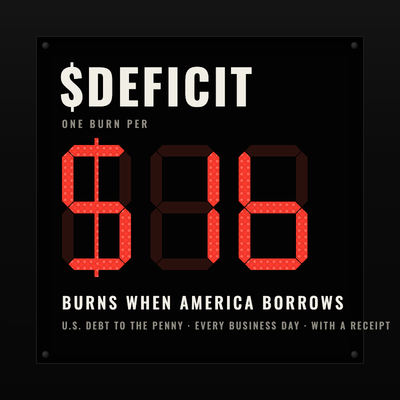
$DEFICIT — burns when the U.S. national debt rises
Every full $1,000,000,000 added to Treasury's Debt to the Penny since the previous business day is one unit; each unit spends 5% of the fee pool buying $DEFICIT at market, and everything bought is burned.
Replay of the real Treasury series, 2025-01 → 2026-10-08 — what the rule would have counted, not a forecast. A memecoin: the rule says what supply does, not what price does.
Open the $DEFICIT page →Who gets what
Its creator-fee share flows to its fee pool, which is the burn budget. Days with no trading are days with small burns. Optionally a disclosed slice (≤ 20%) of creator fees can go to the creator's wallet instead; default 0, shown on the coin's page.
Pays the venue's creation cost and gas. In the default template earns nothing in cash from fees — what they get is a coin whose burns are funded by its own trading. We say this plainly on the review screen.
A platform fee on curve volume and the platform's share of post-graduation LP fees, program-enforced. Nothing from burn pools, ever. Our bots never trade coins launched here, and our own holdings of any coin are shown on its page.
Memecoins. The rule says what supply does, not what price does.
Coins launched on Burnticker have no product, no revenue share and no promise beyond the published rule. Burning supply does not make a price go up; nobody here says it will. We refuse feeds that are prices, disasters, elections or votes; names that impersonate people or institutions; and creators who market returns using our pages.
Every number on every coin page is recomputed from the chain and the source at render time. If the page and the chain disagree, the chain is right. Not investment advice; nothing here is an offer.